

I Have a Crush on You: Marie Corbin & Benoit Maire
At Spazio Nobile’s 10th anniversary, philosopher and visual artist Benoît Maire and scenographer Marie Corbin turn the fleeting moment of a “crush” into a meditation on art, objects, and the gaze. A dialogue between applied and fine arts where nothing is fixed, and everything shimmers between observation and oblivion.
To mark the 10th anniversary of Spazio Nobile, the exhibition “Crush” represents a significant milestone: it affirms a vision of “Gestalt” in which art exists within a space of dialogue between disciplines, in the interaction between artists, and above all between the artwork and the viewer. Philosopher and visual artist Benoît Maire, together with his scenographer alter ego Marie Corbin, engages in an open conversation with the public. The “crush,” understood as a moment of encounter—one of immediate intensity yet difficult to define—thus becomes a key to interpretation that is both physical and mental. It refers to that experience where something happens without being fully graspable: an attraction, a recognition, a relationship. Like ever-changing clouds, the work cannot be confined to a single definition: it is experienced, in time and in the gaze. The “crush” is the living moment that the artists seek to capture, for objects are caught between observation and oblivion.
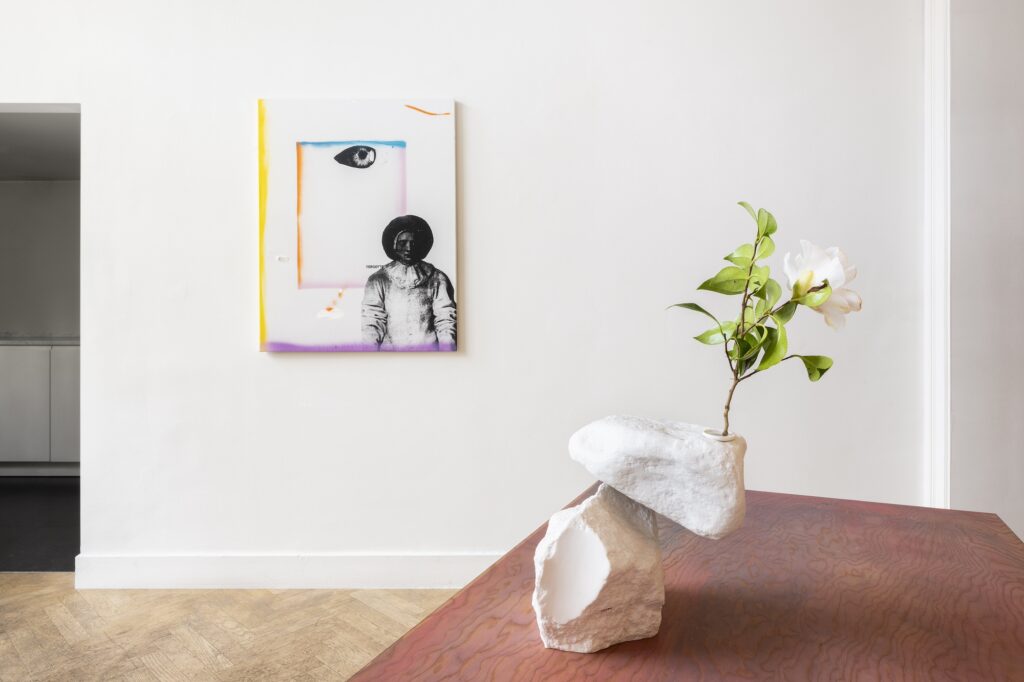
The figure of Pierrot gradually emerged following Benoît Maire’s residency at the Villa Medici in Rome. Originating from the Italian commedia dell’arte, Pierrot once again resonates with the zeitgeist of our era: “Pierrot, reproduced in a group, evokes an image of a crowd—yet one that is fragmented, a crowd of solitudes,” notes the artist in an unpublished essay by art historian and prominent figure in the contemporary art world Gabriela Gantenbein (2024). Where do we stand in this vast landscape devastated by humanity, which we have been constantly rebuilding for millennia by connecting with artifacts? The meaning of the object is established, linked to its origin, a fossil of its era, revealing the state of humanity.
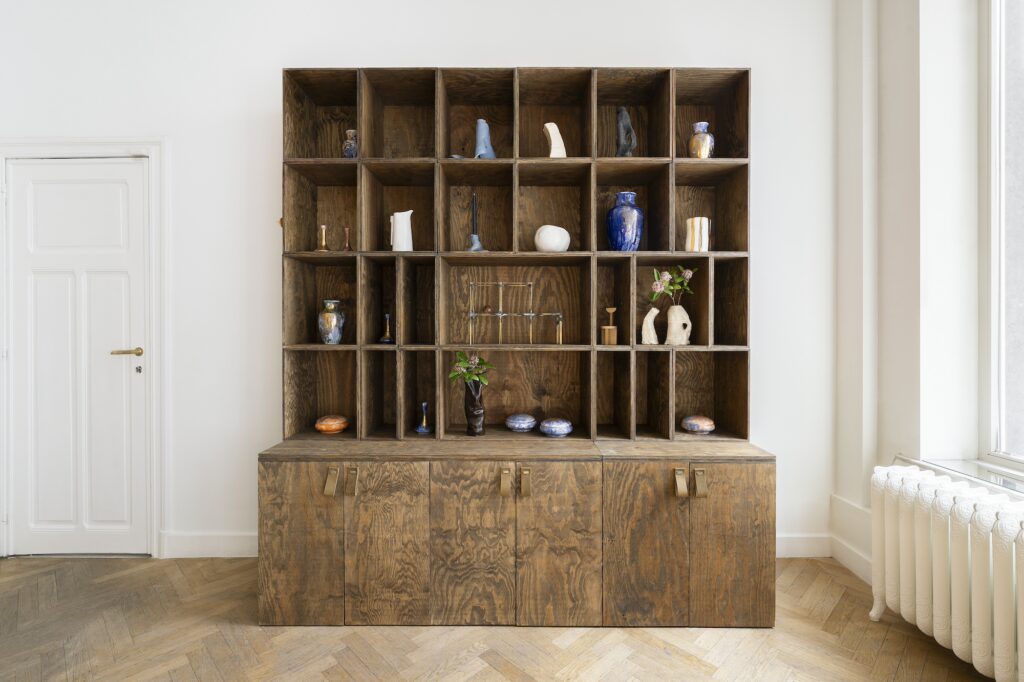
By bringing together applied arts and contemporary fine arts, this exhibition, “Crush,” raises the question of attachment and humanity’s place in relation to the artwork. What is the status of the work of art? If philosophical theory can become, for Benoît Maire, an aesthetic medium—the “cosa mentale” that leads him to create functional objects and paint canvases—it is fascinating to see how he interacts with his collaborator and partner Marie Corbin within “a scenography of the world” that belongs to them. In her “Calme” vases made of Limoges porcelain, delicately painted and glazed in a third firing with gold, like precious abstract and narrative paintings, or in his highly sculptural “Pierre” vase, transcending the fragile presence of a river stone by transforming it into a single-flower vase, Marie Corbin’s sensitivity complements Benoît Maire’s vision.
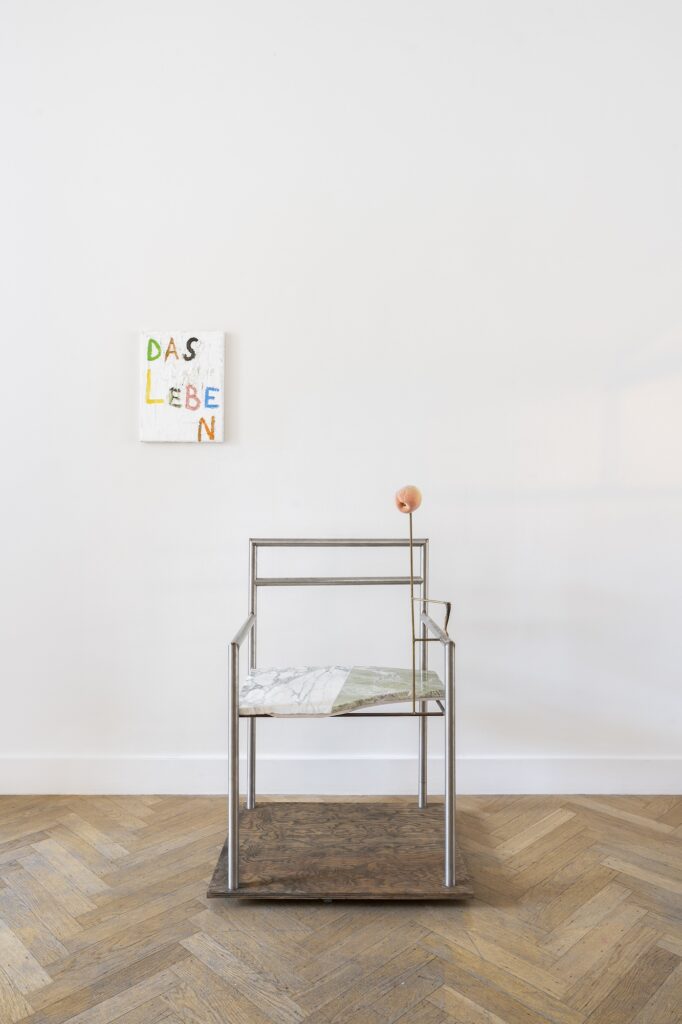
The objects created by two or four hands are expressions of their intuitive experiments. There is a certain atmosphere to their union and their rapport that shines through in the carefully crafted setting of their daily lives—a behind-the-scenes world that echoes their dreams and their fictional and conceptual visions. Benoît Maire is one with his studio in Talence near Bordeaux, where he gives form and life to objects that are often ornamented, even painted, and where he also works on his canvases as discursive and narrative surfaces: space-time is undefined; the dialogue he maintains with the world is a construction, an installation that is part of a process and a “work in progress” where each intervention stems from a quest for truth and meaning.
From paintings of clouds to Pierrot, from the celestial to the terrestrial
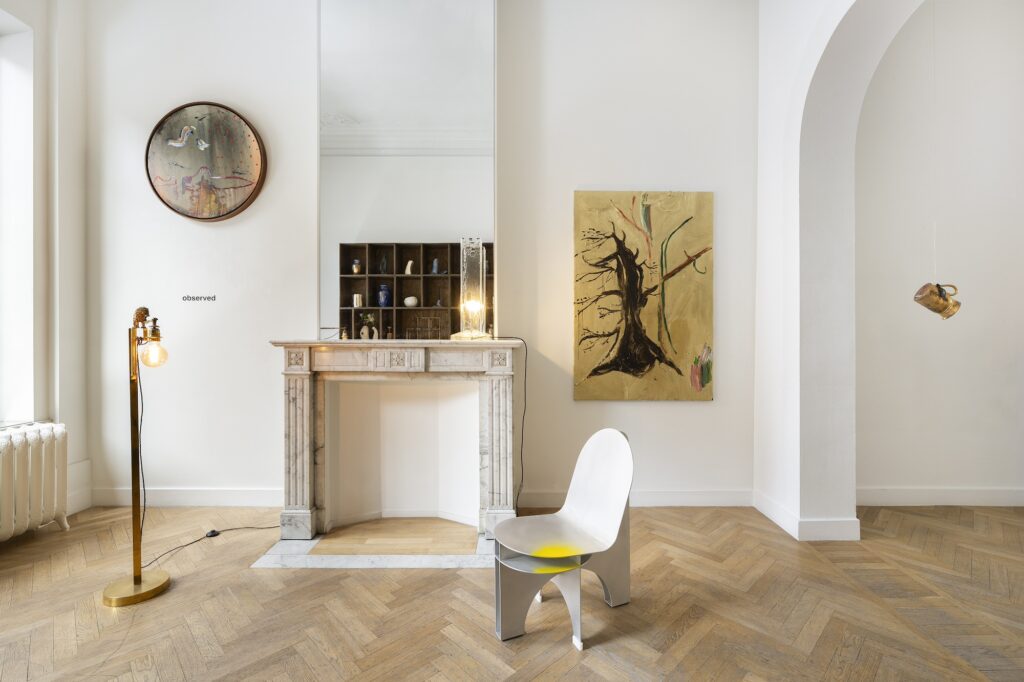
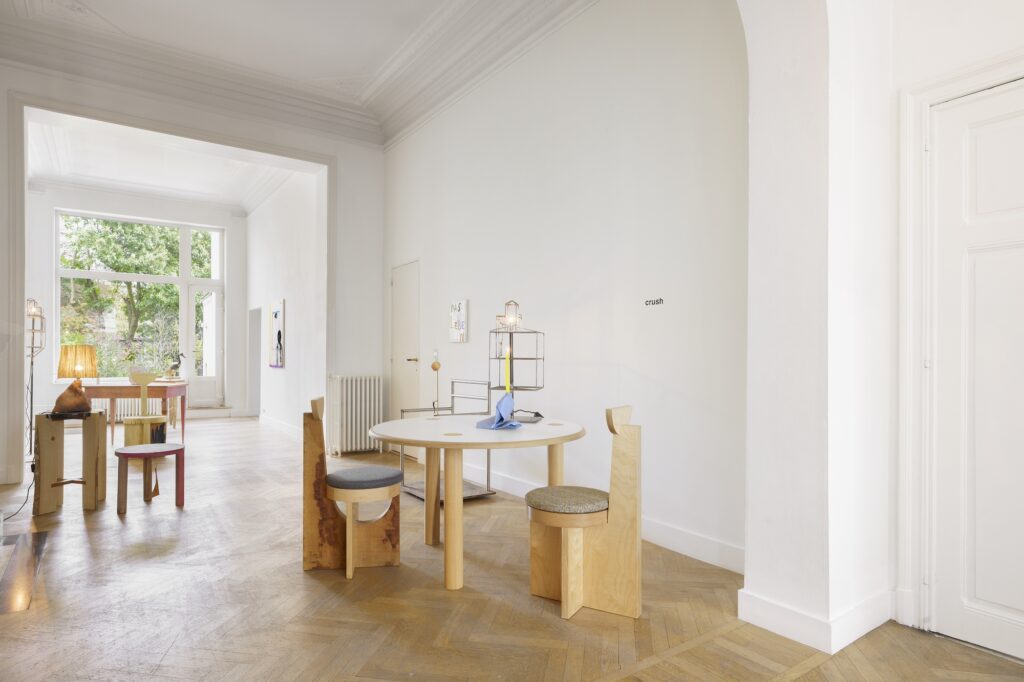
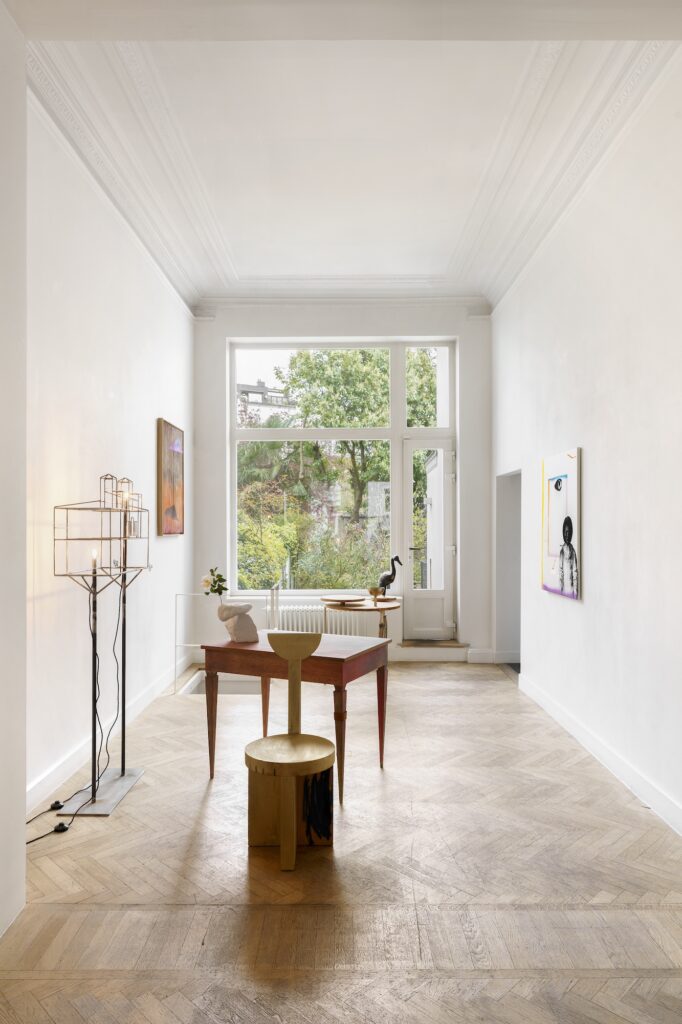
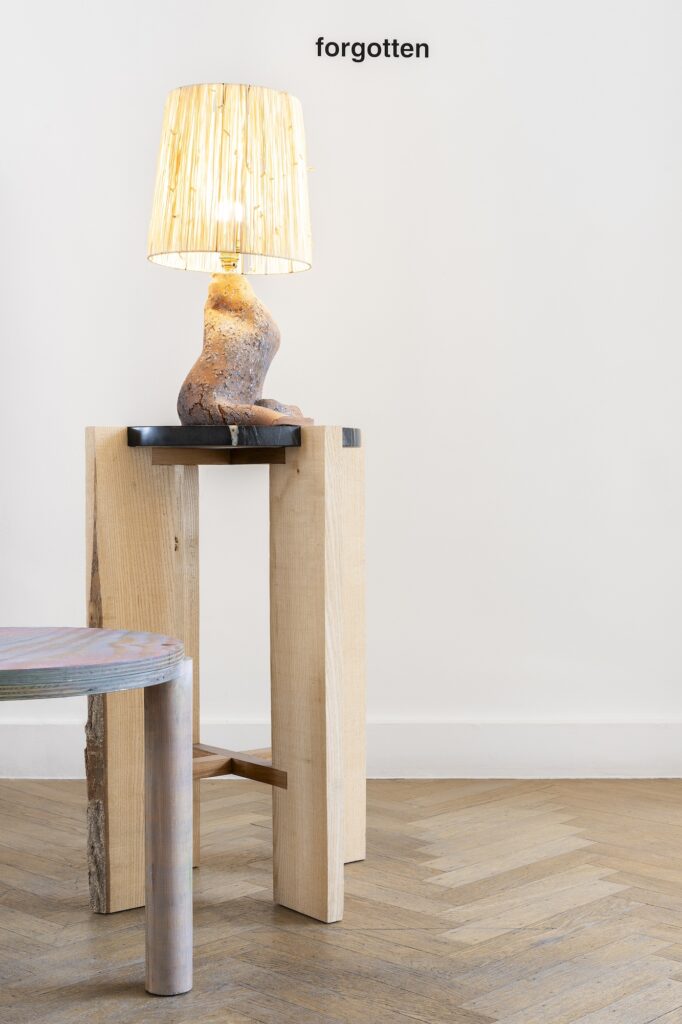
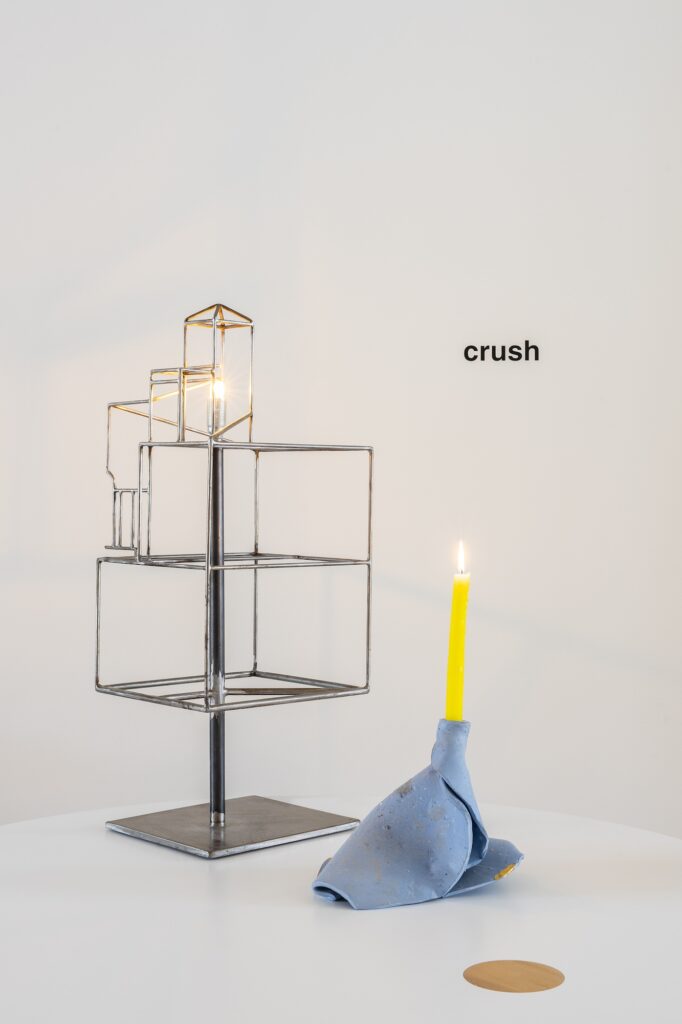
Benoît Maire’s “Cloud Paintings,” as analyzed by the Dutch scholar and video artist Mieke Bal in her essay published in Benoît Maire’s catalog, “Thèbes,” published on the occasion of his exhibition at the CAPC in Bordeaux in 2017, offer a profound reflection on the very nature of painting and on the way we look: an experience of the elusive. At first glance, these works oscillate between abstraction and figuration: landscape, reflection, cloud, or simply a colored surface where nothing imposes itself definitively. The experience of looking is active. The cloud, the central motif, acts as a projection screen for the viewer’s imagination. It compels us to transcend the traditional opposition between abstraction and figuration, opening up an intermediate, “nebulous” space where painting reflects upon itself. For Benoît Maire, painting is not merely representation: it is an event, bearing witness to a relationship caught within a temporality. The work exists fully only in interaction with the viewer. Depending on distance, the movement of the body, and the time devoted to observation, the image transforms. While the “crush” is the privileged moment of the relationship with the work, the painting—like any object of attention—is caught between the limits of observation and oblivion. The exhibition design mirrors the layout of the studio, where an artist’s library serves as a link between the various works. While the space is arranged in a simple, almost primitive manner, the walls bear the words “crush,” “observed,” and “forgotten,” which function conceptually—and, moreover, reference this historically established aesthetic (English words in Helvetica font, affixed to the wall). They refer to the “crush” that lasts only a moment, like a butterfly, between the initial observation and its impending oblivion. Furthermore, the pictorial surface of Benoît Maire’s canvases becomes a site of an almost sculptural experience, where color, material, and light produce an unstable and evolving perception. To look at these works is to enter into a process, to accept that one cannot grasp it immediately, and to allow meaning to emerge from a union of the figurative and the abstract, so that the duration of the “crush”—a fleeting moment by definition—is stretched to its maximum.
While the Cloud Paintings can be understood as a “visual theory of painting,” they also invite us to question the status of the image and the representation of the world. Benoît Maire began his cloud series in Paris in 2012 and continued it in Bordeaux starting in 2016. During his travels, he painted a series in Montreal and another in Mérida, Mexico. In 2021 and 2022, he painted his final cloud canvases during his residency at the Villa Medici in Rome. Beginning in 2024, he will launch a new series of minimalist, so-called “logical” paintings centered on the figure of Pierrot.
Benoît Maire’s painting, drawing on concepts from existential philosophy and combined with the tangible, more functional objects created by Marie Corbin—whether he creates them alone or in collaboration with her within the Ker-Xavier collective—establishes a state of tension between appearance and disappearance, between concept and sensation, and between narrative and a vague, wandering spirit.
Encountering the Other: The Mediating Object, Bearer of Meaning
In the context of the exhibition “Crush,” in dialogue with Marie Corbin, this approach takes on a particular dimension. The convergence of their practices—between applied arts and contemporary fine arts—extends this reflection on the status of the artwork. Just as the cloud in Benoît Maire’s work gradually gives way to Pierrot, the object in Marie Corbin’s work and in their functional art pieces created under the Ker-Xavier banner oscillates between function and meaning, between material presence and mental projection.
In a conversation about ten years ago with the British researcher and art critic Rahma Khazam, prior to the opening of her exhibition at the CAPC in Bordeaux, Benoît Maire spoke about his “system of objects”: “From the very beginning, I shape my objects, which means that the material is subject to constraints—most often, those of a concept. But I have also used theories to constrain the material, as well as mythologies: there was Tiresias, there were the Greek heads, and so on. When I was working on the history of geometry, it was mathematics that helped me constrain the forms of my sculptures. I make a lot of furniture for our architecture brand called Ker-Xavier. These are forms constrained by the use we’ll make of them, because you have to be able to sit on this furniture. What constraints are placed on materials to turn them into objects? In my case, objects and furniture are constrained by concepts, stories, mythologies, and uses.”
While ornamentation, patina, paint, and materiality feature prominently in the works of Marie Corbin and Benoît Maire, they are also a source of creation, transformation, and metamorphosis. Nothing is fixed; everything can move, appear, and disappear, and as Marie Corbin inscribes at the heart of her glazed porcelain boxes: “Sans début, sans fin” (“No beginning, no end”)…
“Crush” is on view at Spazio Nobile Gallery through June 13, 2026.

Articles you also might like
From March 18-25, 2026, Spazio Nobile presents Memories of a Garden, a colourful and captivating series of new work by Kiki van Eijk that captures the designer’s vivid imagination and the impact that nature and the landscape has on her practice.
On Saturday, March 14th, Belgian textile designer Vera Vermeersch will open her studio between 12-20h, offering visitors the opportunity to see her latest work, works-in progress, and have a unique glimpse into this prolific artist’s process and vision.
Our 2026 print edition: TLmag41: The Art of Collecting, guest edited by Simon de Pury, is now available on newsstands and online. Have a look!
From February 12-15, NOMAD design fair returns to St. Moritz for its ninth edition, transforming the recently renovated Villa Beaulieu—formerly Klinik Gut—into an intimate showcase for contemporary art, collectible design, and jewellery.