

Chisato Yasui: Monad
TLmag interviewed Japanese ceramic artist Chisato Yasui after the opening of Monad, an exhibition of her ceramic sculptures at Spazio Nobile Studiolo. The exhibition is on view through November 15th. This interview has been edited and condensed.
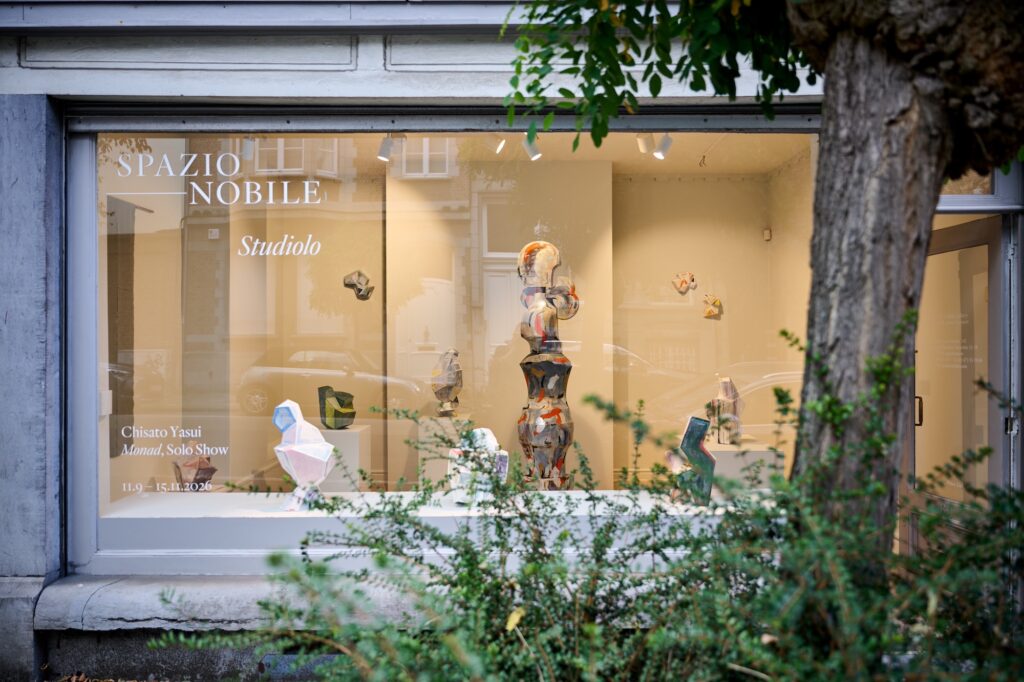
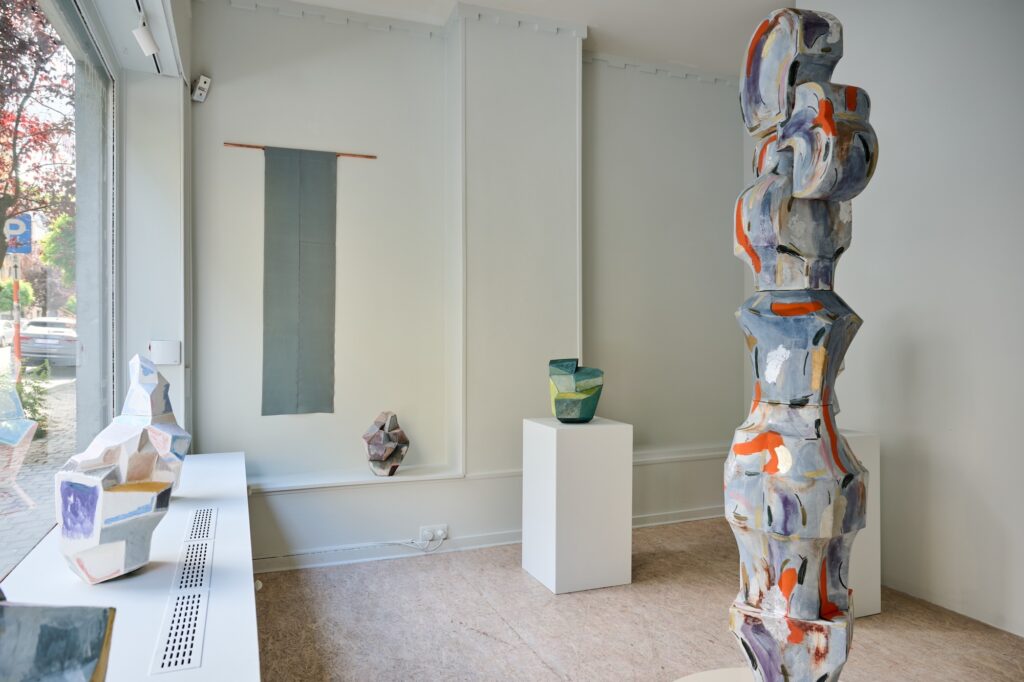
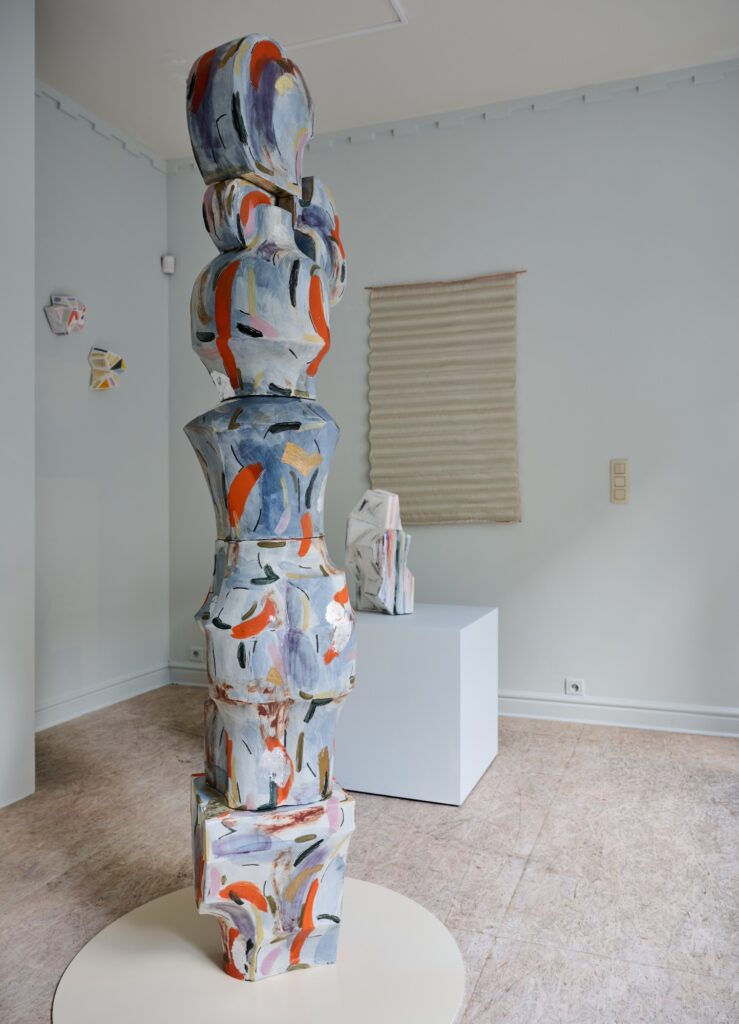
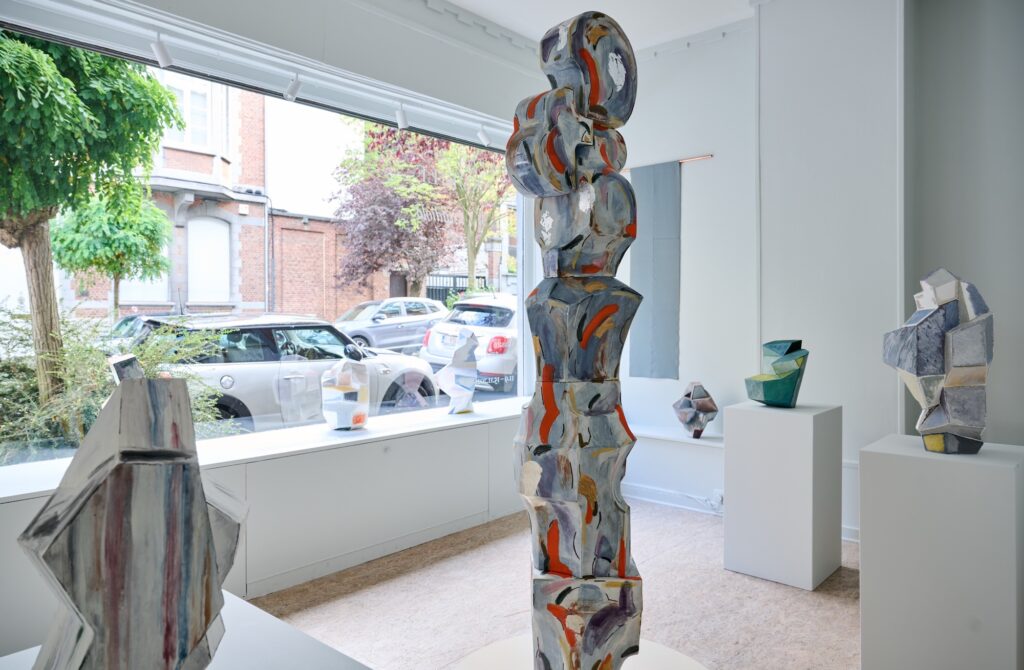
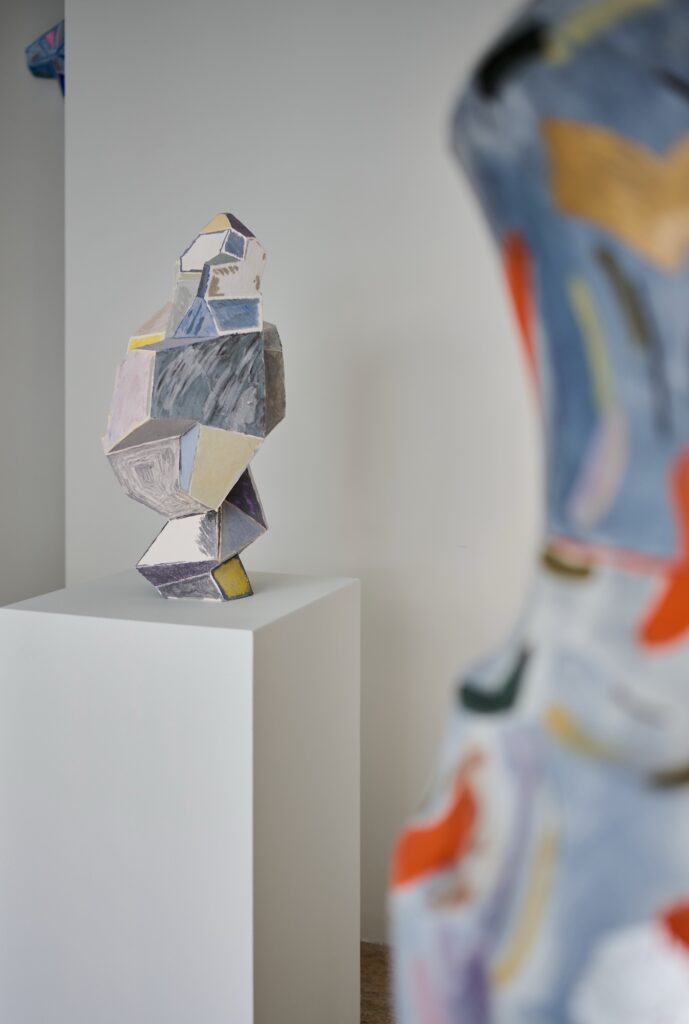
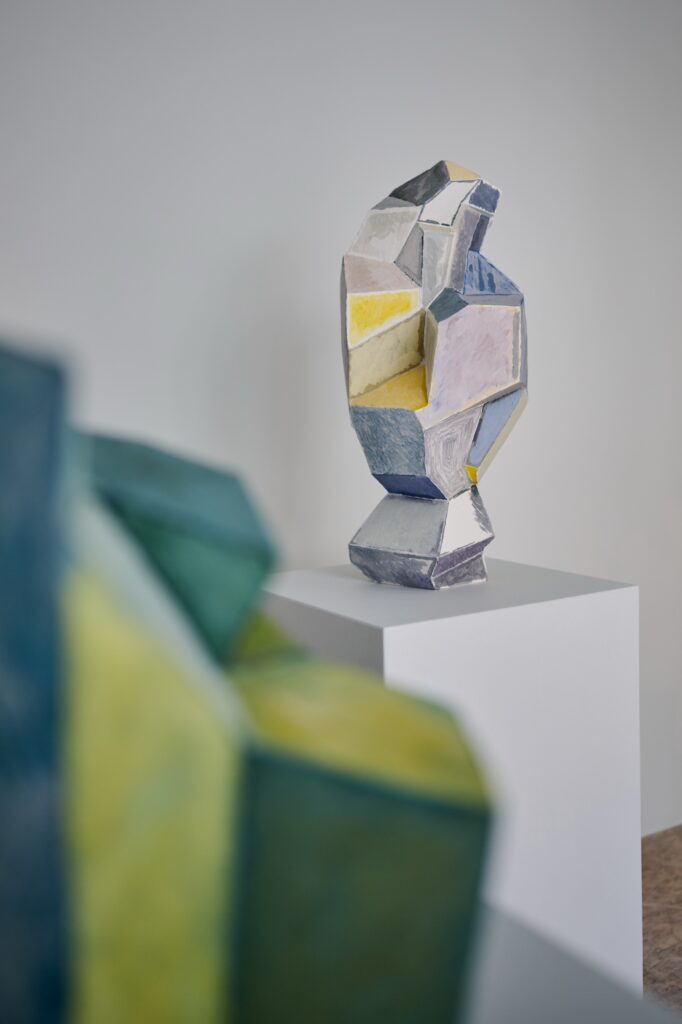
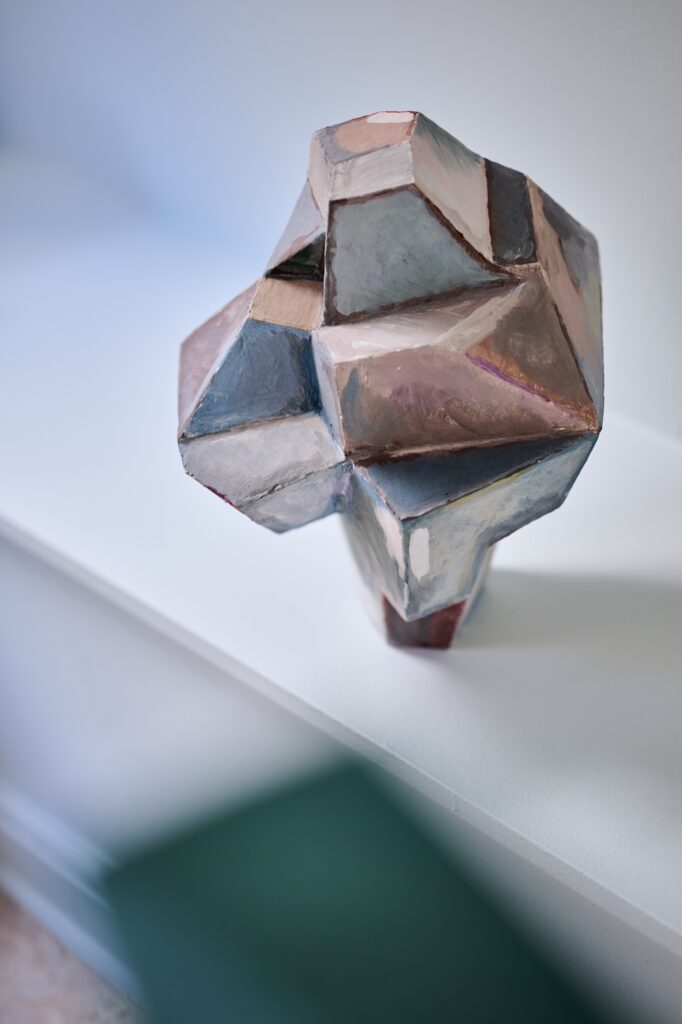
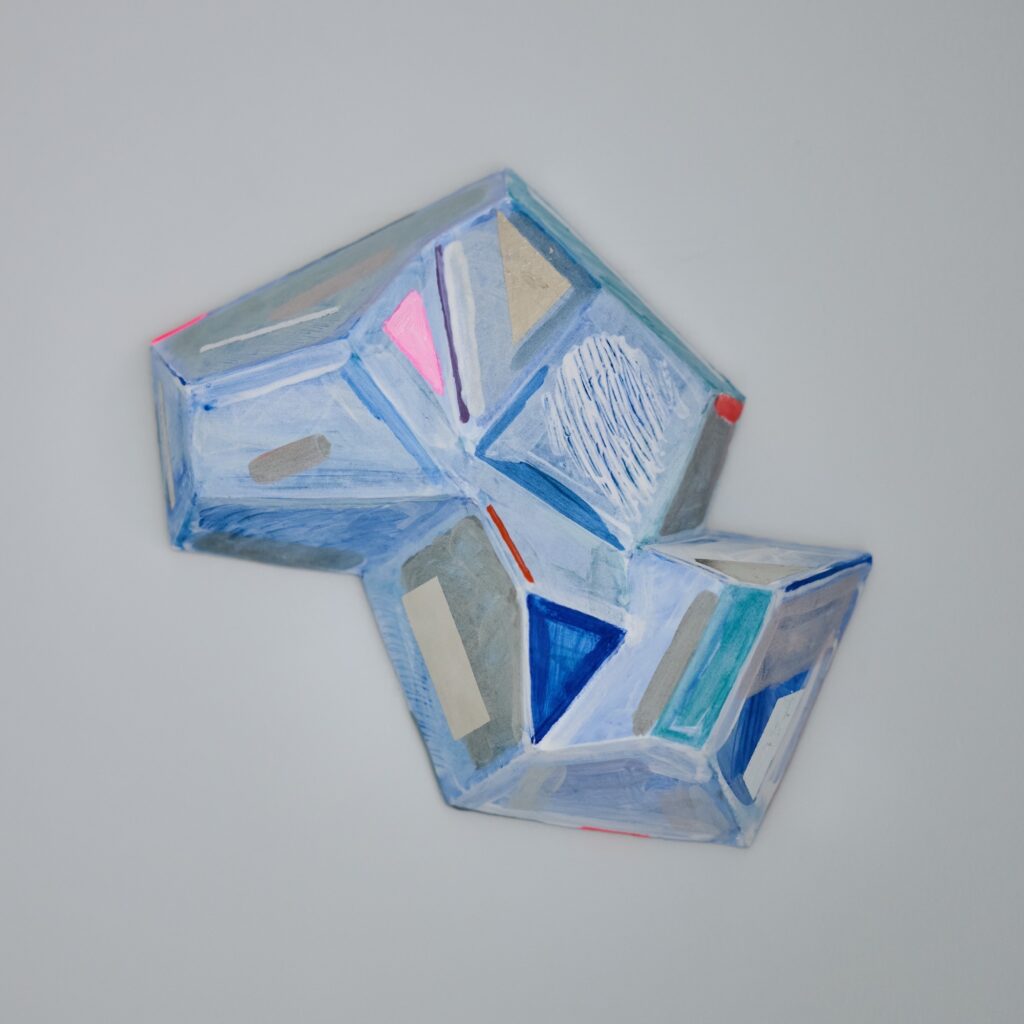
Inspired by Japanese philosopher Kitaro Nishida’s concept of Basho (“place”), Chisato Yasui’s solo show explores interconnected inner and outer worlds through 11 painterly ceramic sculptures. Entirely hand-built in porcelain and stoneware, the works combine acrylic and oil painting after firing to create luminous forms balancing spontaneity and control. Merging sculptural volume with expressive gesture, Yasui’s vessels embody both material presence and introspective depth—spiritual microcosms of layered perception and consciousness.
TLmag: The exhibition is titled Monad, yet you’ve said the Japanese word Awai feels truer to what the show became — that fragile in-between space where meanings haven’t yet settled. Can you talk about that tension between the philosophical, self-contained idea of a monad and the more fluid, relational space of Awai?
Chisato Yasui: The title Monad was actually proposed by Spazio Nobile, not by me. When I first heard it, I found it interesting that they saw my work through this idea, so rather than rejecting it or immediately deciding what it should mean for me, I wanted to try looking at my own work from their perspective. At that time, I understood monad rather simply as an individual, self-contained existence, while Awai felt much closer to my own experience of making: something relational, fluid, and still in the process of becoming. Awai felt more truthful to what the exhibition had become through my practice. For me, Awai is a place where bodily sensations, memories, words, and feelings remain close together before they separate into clearer meanings. I once saw it as distinct from monad, but, as I have continued thinking about monad, the line between them has begun to blur. A monad is not merely individual and self-contained. It has its own inner principle and continues to change from within, while expressing the world from its particular point of view. This made me wonder whether monad and Awai might not be opposites after all, but two different ways of approaching the same condition. Perhaps monad names the singularity that remains unmistakably itself, while Awai describes the condition in which that singularity continues to take form through relation.
This feels very close to my way of making. I do not begin with a fixed image. Form emerges through repetition, bodily rhythm, the weight and resistance of clay, and my response to what is happening. Even when a work is finished, I do not really feel that it has reached a final form. It feels more like one moment captured from a continuous movement. I am still thinking about what these words mean for me. Often, a word comes to me intuitively before I fully understand why I need it. Then I continue to live with it through making. So rather than arriving at a conclusion, I feel I am discovering something through this exhibition: how something can remain singular—unmistakably itself—while still being formed, and continually becoming, through its relations with the world.
TLmag: The studiolo is a unique space, both in its size and that it offers a window right onto the street for people to gaze in. Did this effect how you thought about the work you wanted to show or how you installed it?
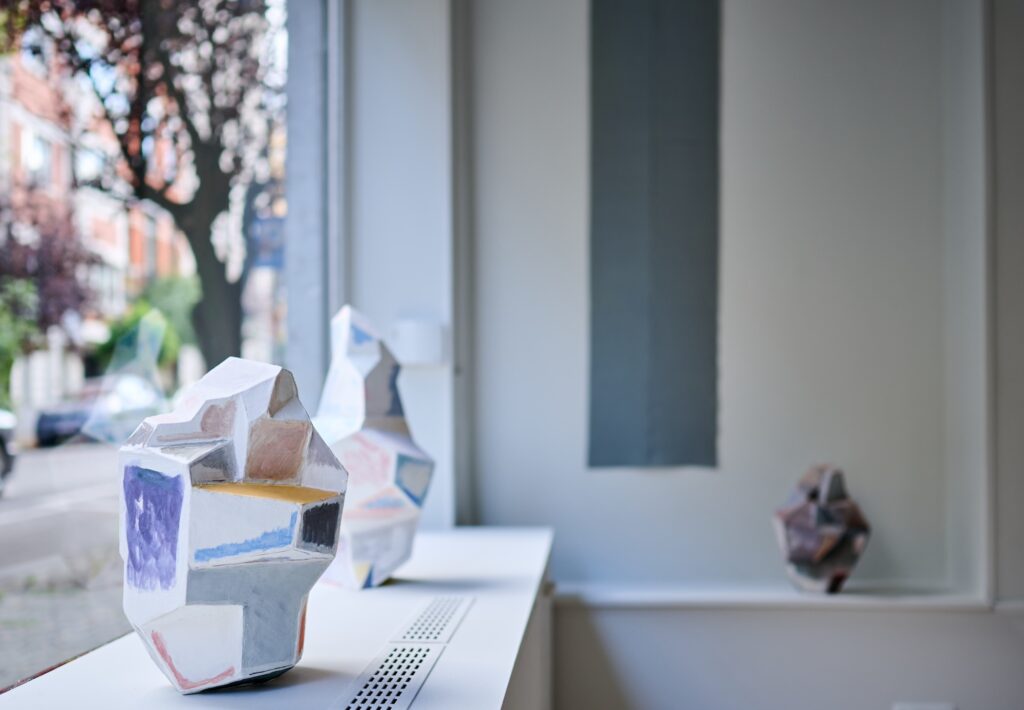
C.Y.: I actually never make a detailed plan for how I will install my work. This is almost the same as the way I make the work itself. Until I physically enter a space together with the works, I cannot really know what will happen there. I want to respond to what is actually occurring—the scale of the room, the light, the distances between things, and the way the works begin to speak to one another. So, installation is, for me, a kind of improvisation. Perhaps it could even be called an event: something that can only happen at that particular moment, in that particular place. When I first entered the Studiolo, however, I immediately felt that it was a very interesting space. I could begin a dialogue with it almost instantly, so I did not struggle very much with where each work should be placed. As I placed the works, I carefully explored the distances between them. I wanted each piece to retain the space it needed while allowing the works to resonate with one another. I also paid close attention to the view through the Studiolo’s large window from the street. Outside the glass, ordinary life continues. People are walking, talking, eating, going somewhere. Inside, there is a completely different sense of time and space—the more concentrated atmosphere of an exhibition. But because the window faces the street directly, these two worlds are never completely separated. The glass divides them, but at the same time keeps them connected. In arranging the works, I wanted to make sure that every piece could be seen from outside. I wanted to draw out the particular sense of depth offered by that viewpoint, so that the interior would feel deeper than its actual dimensions. The orientation of each piece mattered, too, because it determined which of the work’s expressions would be visible from the street.
TLmag: Your practice draws on Kitaro Nishida’s concepts of Basho (“place”) and Kagami (“mirror”). How did you first encounter these ideas, and how do they translate — practically, physically — into decisions you make while building a piece?
C.Y.: I first encountered Kitaro Nishida’s philosophy when I was in graduate school, while researching for my master’s thesis. I believe I first came across him through Shinichi Nakazawa’s Art Anthropology. At that time, I was struggling to put into words what I was actually doing when I worked with ceramics. Sensation always moved faster than language. When I encountered Nishida’s ideas of Basho, or “place,” and his way of thinking through the image of the mirror, I felt almost as if he had been observing my experience of making from inside me. His philosophy helped me understand that what happens in making does not begin with a separate “self” imposing an image on a separate material. There is first a field in which my body, the clay, gravity, time, memory, sensation, and the emerging work all exist together and affect what can happen next. That is very close to how I actually build. I begin without a fixed image. I stack thin coils of clay, one by one. After each movement, I look again. The clay has weight, softness, resistance and fragility; gravity changes it; my own body changes with it. I make a decision, the material answers, and that answer changes my next decision. In that sense, I have come to experience ceramics itself as both a kind of Basho and a kind of mirror. I am shaping the clay, but what appears in front of me also reflects something back and changes me.
What Nishida gave me was not a method to apply, but a way to trust this intuitive process. It gave me a deep sense of reassurance that seemingly contradictory things—inside and outside, self and world, making and being made—do not always have to be reduced to one side or the other. They can coexist within a larger field. This also changed how I understand my own practice. I have created many different series, not only the works shown in the Studiolo. Early in my career, I sometimes thought this variety might be a weakness, as if an artist should have one consistent visual language. Gradually, I came to see it differently. If I truly listen to what arises in the encounter with material, different forms may naturally emerge. Nishida’s thought helped me accept that multiplicity without feeling that I was losing myself. This doesn’t mean I think about his philosophy while I am making a piece. Instead, it works quietly in the background. It gave language to something my body already knew, and perhaps more importantly, it gave me permission to continue listening to what happens before I can fully explain it.
TLmag: You work almost entirely through coiling, and you’ve described its rhythm as resonating with your own bodily sensibility. Can you walk us through what a typical piece’s journey looks like, from the first coil to the final firing — and how much of the final form is decided in advance versus discovered through the making?
C.Y.: When it comes to making form, and when it comes to color, I do not know the answer from the beginning. Perhaps that is precisely why I continue making. To encounter something that I myself cannot yet fully recognize. And as I draw lines with clay, build form, layer color, and pass the work through fire, that something gradually appears in this world. Only through its appearance do I myself also begin, little by little, to understand what it may have been. For me, making is this kind of journey.At the very beginning of making, there is an empty studio, an empty table, and in front of me a wooden board that will serve as the base for the work, with nothing yet appearing on it. And there is me, feeling that something may be about to emerge. That is all. Most of the time, even I do not know what kind of form will have appeared when the work is finished. I think I continue this journey with ceramics as a material in order to encounter something I cannot yet fully recognize, and, while drawing lines with clay, to gradually discover what it is trying to become.
The only practical limitation that exists at the beginning is the size of the interior space of my kiln. Before I begin, I have a bodily sense of an approximate “volume,” as though something is stirring inside me. I still do not know its specific form. But I can somehow sense whether that volume will fit within the size of the kiln, or whether, in order for it to emerge fully, I will need to form it as several separate pieces. That feeling determines the size of the wooden board I use as the base for making. While sensing with my whole body the “volume” of something that seems about to emerge, I reach into a large mass of clay and tear off the amount that feels necessary for the first layer. I squeeze and stretch it with my hands until it becomes a relatively thin, long rope of clay. Then I place that single rope of clay on the board and make a circle, as large as possible within the limits of the board. I imagine it as something like a low, circular embankment of clay. That circle becomes the beginning of the work. When the circle appears, I feel as though a “gate” opens somewhere inside me. It almost feels as though I can hear the sound of that gate opening. My body, too, seems to recognize that “the dialogue between the clay and me has begun,” and I feel my mind and my senses begin to open. As I continue this dialogue with the clay, there eventually comes a moment when I feel that the volume I sensed within me has been brought out into this world as fully as I can manage. That is where the forming ends. As I mentioned at the beginning, I have an approximate bodily sense of the dimensions of the kiln interior, so that sensed boundary also becomes one of the indications that tell me when the making of the form should come to an end.
TLmag: You began in oil painting before moving to ceramics, but your work still retains a very painterly palette and aesthetic – the brushstrokes, layered pigments, underglazes, multiple firings up to four times at different temperatures. How do you think about color differently now, applying it to a three-dimensional, fired surface, then you did on canvas?
C.Y.: I do not think my love and longing for color have changed at all, but I think I have become freer in how I think about it. I painted in oils from my first year of junior high school through my first year of university. During that time, the subjects and motifs I painted were always outside myself. Yet even as I painted them, I was applying not their visible colors, but the colors arising within me at that moment. What I wanted to paint was color, but the colors I used bore no relation to those of the subjects themselves. I struggled with that gap.
Now, the ceramic body itself has become my “canvas.” Within me, there are colors that exist alongside many different experiences, memories, and sensations. The place where these colors are held is, for me, the source of my images. The form itself—the ceramic canvas—also comes from that same source. When I stand before the ceramic body and sense its colors, I feel as though they come from within the work, together with light. Perhaps this is because, as the form comes into being through the clay, it brings color with it from the source of my inner images. I also think this means that, at the same time, I am discovering my own colors through making. They are colors that live alongside me, and yet I also feel that they have an autonomous existence of their own. Since coming to recognize this, I have been able to engage with color more freely and intuitively. Color guides the stroke; color guides color. Whatever color arises, I have also come to feel that it is a color living here and now. The time I spend capturing that moment together with the material feels truly rich, and I feel happy.
TLmag: You’ve spoken about how pregnancy during your graduate studies changed your understanding of creation — the vessel as something shaped between interior and exterior, unseen yet present. Does that idea still inform how you approach the hollow, holding form of a piece today?
C.Y.: Yes, I think that experience still lives within the way I work. During pregnancy, I felt the wonder of another life growing inside my body. We were connected, yet she was someone other than me. Although I could not see her directly, I could feel my daughter growing and my own sensations changing with her. Making with clay and glass began to feel close to the processes of life themselves. During childbirth, I felt my body responding to my daughter’s strength as she tried to be born. There were moments when releasing my own effort and trusting her strength became a way of supporting her. Perhaps something of that experience remains in how I respond today to a form emerging through clay. As I build, the clay gradually becomes a skin around something I can sense but cannot yet fully recognize. The hollow space matters to me because I can leave room there for something unknown to emerge. When I close the form, I feel that it protects what has appeared, without explaining it.
TLmag: This show marks 160 years of friendship between Japan and Belgium, and your work now lives between Aichi, where you were born, and your practice’s dialogue with a European gallery context. Does where you physically work — your studio, your surroundings — shape the “in-between” quality you’re describing, or is Awai something you’d find in the clay regardless of place?
C.Y.: Do I find Awai within the relationship I have built, and continue to build, with ceramics, regardless of place? In one sense, yes; in another, no. At any time, in any place, even outside the studio, I find Awai within the relationship I have built, and continue to build, with ceramics. But what kind of environment I am in, how I spend my time, what relationships I have, and what state those relationships are in—all of these matter. The climate and character of the land also strongly affect the relationship between the clay and me―that “place.” For me, the places I ordinarily inhabit include not only my studio, but also my everyday psychological environment, my relationships, and the places I engage with through my body. Within this, the studio is a kind of sanctuary. I remain connected to society and my everyday roles, but for a time, my engagement with them seems to pause.
Outside the studio, things continue to flow, whether or not they have anything to do with me. While remaining connected to that flow, the studio seems to hold another kind of time, an order that exists only there. When I place myself there, I retain my everyday sensations, yet feel a circuit that operates only in the studio begin to turn at tremendous speed. I think place exists within and outside oneself, and between oneself and others, sometimes encompassing someone else, and is continually transforming. Something like its organic ecology, felt through the body, enters into the dialogue with clay, mingling like liquids and becoming a distinctive form. I think the diversity among my series also reflects these differences.

Articles you also might like
A new artist monograph co-published by Flammarion and Spazio Nobile Gallery invites readers into the captivating world of Bela Silva, the renowned Portuguese contemporary artist and ceramist who is redefining the boundaries of ceramic art. Two book signings are taking place this fall in Paris and Brussels.
The 2nd edition of Craft x Tech was presented at the V&A during London Design Festival 2026, and featured six new collaborations pairing Tokai artisans with international designers and artists. Together, they explored new creative possibilities and produced contemporary works that celebrate the continuing relevance of traditional craftsmanship.
Japanese craftsmanship and contemporary creation on are display in Echoes of Wa, a poetic exhibition at Spazio Nobile that features work by Mae Engelgeer & Japanese Master ceramicist Matsubayashi Hosai XVI.
RendezVous – Brussels Art Week kicks off the city’s fall art season with nearly 100 participating venues across the city hosting events, exhibitions, and talks all weekend long.